

Slip disc is a common spinal condition that can cause persistent back pain, neck pain, numbness, tingling and weakness in the arms or legs. It develops when the soft inner portion of a spinal disc moves through a weakened area of its outer covering. If the displaced disc material presses on a nearby nerve, it may cause pain that travels from the spine into other parts of the body. The symptoms and their severity depend on the location of the affected disc and the degree of nerve compression. Slip Disc Treatment in Bilaspur involves identifying the affected spinal level, understanding the symptoms and selecting an appropriate treatment approach. Some patients improve with medicines, activity modification and supervised physiotherapy, while others may require further evaluation for a surgical procedure. Dr. Abhishek Kumar Shah, associated with Shri Shah Neuro Hospital, Bilaspur, is a neurosurgeon with MBBS, MS and MCh qualifications and 14 years of experience, as provided for his professional profile.
Patients looking for the Best Neurosurgeon in Bilaspur for a spinal condition should consider the specialist’s qualifications, experience, diagnostic approach and ability to explain both surgical and non-surgical treatment options.
Slip Disc Treatment in Bilaspur – Dr. Abhishek Kumar Shah
Dr. Abhishek Kumar Shah is a neurosurgeon associated with Shri Shah Neuro Hospital in Bilaspur, Chhattisgarh. His qualifications include MBBS, MS and MCh, and his professional profile has been provided with 14 years of experience. Neurosurgery deals with conditions affecting the brain, spinal cord, spine and nervous system.
A spinal problem may involve the bones, discs, spinal canal or nerves. A patient may experience local back discomfort, pain travelling into the leg, neck pain extending towards the arm or changes in muscle strength and sensation.
When choosing the Best Neurosurgeon in Bilaspur, patients should look for a qualified specialist who can explain the diagnosis, review relevant scans and discuss the benefits and limitations of available treatments. The treatment plan should be based on the patient’s symptoms and clinical findings rather than on an MRI report alone.
What Is a Slip Disc and How Does It Affect the Spine?
Between these bones are soft, cushion-like structures known as intervertebral discs. They help absorb pressure, support spinal movement and maintain space between neighbouring vertebrae.
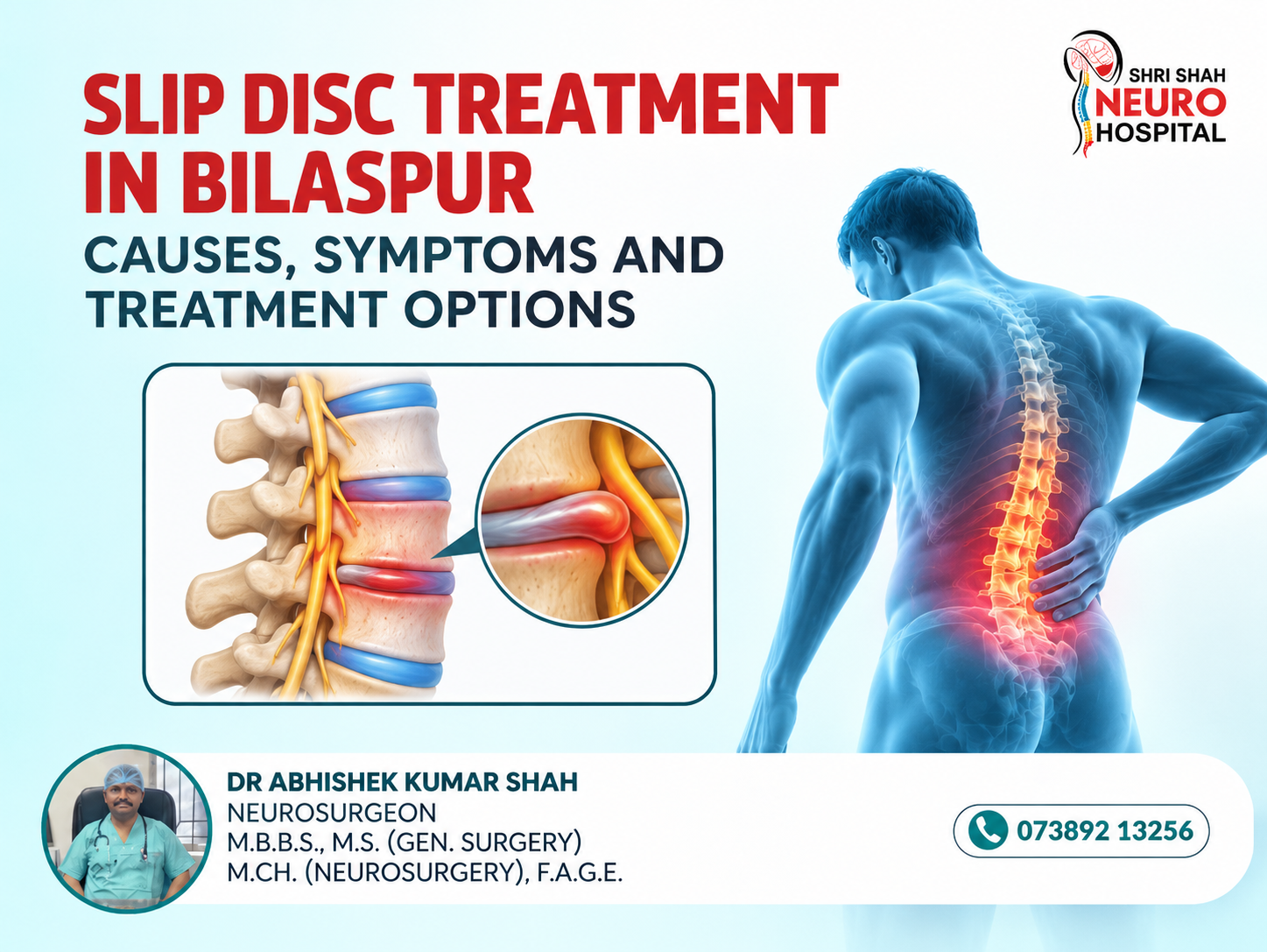
Each disc has a tough outer layer and a softer inner material. A slip disc, medically called a herniated or prolapsed disc, occurs when some of the inner material pushes through a weakened or damaged part of the outer layer. When this material irritates or compresses a nearby nerve, it may cause pain, tingling, numbness or muscle weakness.
A disc herniation can occur in different regions of the spine:
- Cervical disc herniation: Occurs in the neck and may cause neck pain, shoulder discomfort or symptoms extending into the arm and hand.
- Thoracic disc herniation: Occurs in the middle portion of the spine. It is less common and may cause pain around the chest or upper back.
- Lumbar disc herniation: Occurs in the lower back and may cause lower back pain, buttock pain or pain travelling down one leg.
The location of the disc problem is important because it influences the symptoms, investigations and treatment options. Slip Disc Treatment in Bilaspur should therefore begin with an assessment of the affected spinal region and the nerves that may be involved.
Common Causes of a Slip Disc
A slipped disc can develop gradually due to age-related changes or following an injury. Several factors may increase the pressure on spinal discs or make them more vulnerable to damage.
1. Age-Related Changes in Spinal Discs
As people grow older, spinal discs gradually lose some of their water content and flexibility. This process can make the discs less effective at absorbing pressure. Small cracks or weak areas may develop in the outer layer, increasing the possibility of disc herniation.
2. Incorrect Lifting and Repeated Bending
Lifting heavy objects while bending from the waist can place additional stress on the lower back. Repeated bending, twisting and lifting may also increase the load on spinal structures, particularly when performed with poor posture.
3. Prolonged Sitting and Poor Posture
Long hours of sitting without movement breaks may contribute to back discomfort. Sitting in an unsupported position can place additional pressure on the lower back. People who work at desks or drive for extended periods should pay attention to their sitting posture and regular movement.
4. Sudden Injury or Physical Strain
A fall, accident or sudden twisting movement can sometimes damage a spinal disc. In some cases, symptoms begin immediately after an injury, while in others they develop gradually.
5. Excess Body Weight
Additional body weight can increase the mechanical load on the spine, particularly the lumbar region. This may contribute to discomfort and place extra stress on spinal structures.
6. Limited Physical Activity
The muscles around the abdomen, back and hips help support the spine during movement. Reduced activity and weak supporting muscles may affect movement patterns and spinal support.
Symptoms of a Slip Disc You Should Not Ignore
Some people experience only back or neck pain, while others develop symptoms in their arms or legs.
Common signs include:
- Persistent lower back or neck pain
- Pain spreading from the lower back into the buttock or leg
- Neck pain travelling towards the shoulder, arm or hand
- Tingling or pins-and-needles sensations
- Numbness in the arms, hands, legs or feet
- Muscle weakness in an affected limb
- Pain that increases with certain movements, coughing or sneezing
- Difficulty standing, walking or performing everyday activities
A slipped disc may also cause sciatica when a lumbar nerve is irritated. Sciatica commonly causes pain that travels from the lower back or buttock down the leg. However, similar symptoms can occur with other spinal or nerve conditions, so an examination is important.
Patients experiencing persistent symptoms may need Slip Disc Treatment in Bilaspur after a specialist has assessed the cause of the problem. New or worsening weakness should not be ignored.
Warning Signs That Require Urgent Medical Attention
Certain symptoms may indicate serious compression of the nerves at the lower end of the spinal canal. These include:
- New difficulty passing urine or inability to control urination
- Loss of bowel control
- Numbness around the groin, inner thighs or genital area
- Severe or rapidly worsening weakness in one or both legs
These symptoms may be associated with cauda equina syndrome, which is a medical emergency. Anyone experiencing them should seek emergency medical attention immediately rather than waiting for a routine appointment.
Slip Disc Treatment in Bilaspur for Patients from Mangla Chowk and Nearby Areas
People living in different parts of Bilaspur may experience back pain, neck discomfort or symptoms related to nerve compression. Patients from Mangla Chowk, Narmada Nagar, Sarkanda, Nehru Nagar and Vyapar Vihar may look for information about spinal care and suitable medical evaluation.
The location of the pain alone cannot confirm a slipped disc. A doctor needs to understand the symptoms, examine muscle strength and sensation, and decide whether an imaging test is necessary. For patients comparing options for the Best Neurosurgeon in Bilaspur, it is useful to consider the specialist’s qualifications, experience with neurological conditions and the availability of appropriate diagnostic support.
When searching for a slip disc specialist near Mangla Chowk or a neurosurgeon for back pain in Sarkanda, patients should focus on receiving a correct diagnosis rather than selecting treatment based only on online descriptions. The same applies to people travelling from Narmada Nagar, Nehru Nagar and Vyapar Vihar. These localities are useful location references, but they do not indicate separate hospital branches.
How Is a Slip Disc Diagnosed?
Diagnosis usually begins with a discussion about the patient’s symptoms and medical history, followed by a physical and neurological examination. The doctor may ask when the pain started, whether it travels into an arm or leg, which movements make it worse and whether there is any numbness or weakness.
The examination may include:
- Checking muscle strength in the arms and legs
- Assessing reflexes
- Checking sensation in different areas
- Observing walking and balance
- Assessing spinal movement
- Performing selected clinical tests for nerve irritation
Depending on the findings, the doctor may recommend one or more investigations.
MRI Scan
Magnetic Resonance Imaging (MRI) provides detailed images of spinal discs, nerves and other soft tissues. It is commonly used when a doctor needs to assess suspected disc herniation, nerve compression or other soft-tissue problems.
X-ray
An X-ray shows the alignment and structure of the spinal bones. It may help identify certain bone-related changes, but it does not directly show the soft disc material or provide the same detail about nerves as an MRI.
CT Scan
A Computed Tomography (CT) scan creates detailed images of the spinal bones. Some people may have disc changes on an MRI without experiencing pain.
Advanced Slip Disc Treatment in Bilaspur – Non-Surgical Options
Treatment depends on the location of the disc herniation, the severity of pain, the presence of nerve compression and the patient’s overall health. Many patients can initially be managed without surgery.
1. Medicines Under Medical Supervision
A doctor may prescribe medicines to help manage pain or inflammation, depending on the patient’s condition. The choice of medicine depends on medical history, other medications and possible side effects. Patients should not start or continue prescription medicines without appropriate medical guidance.
2. Physiotherapy and Rehabilitation
A supervised physiotherapy programme may help improve movement, flexibility and the strength of supporting muscles.
3. Activity Modification
Prolonged bed rest is generally not recommended unless a treating doctor advises otherwise.
4. Selected Injection Procedures
In some cases, a specialist may consider an injection around an irritated nerve to help manage symptoms The right Slip Disc Treatment in Bilaspur plan should be individualised. The aim is to manage symptoms, maintain safe movement and address nerve compression when necessary.
When Is Slip Disc Surgery Required?
Progressive muscle weakness and certain emergency symptoms may require urgent surgical assessment.
The decision to operate depends on several factors:
- The location and extent of the disc herniation
- Severity and duration of symptoms
- Whether a nerve or the spinal cord is compressed
- Presence of muscle weakness or changes in sensation
- Response to non-surgical treatment
- The patient’s general health and medical history
A neurosurgeon can explain whether an operation is appropriate, what the procedure involves and what recovery may look like. Patients should also understand the possible complications and alternative treatment options before making a decision.
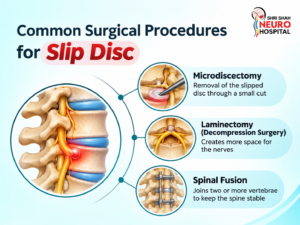
Common Surgical Procedures for Slip Disc
Different procedures may be considered depending on the spinal region, the location of the disc material and the type of nerve compression. The most suitable technique is selected after reviewing the patient’s condition and investigation reports.
Microdiscectomy
Microdiscectomy is a surgical procedure in which the surgeon removes the portion of disc material pressing on a nerve. It is commonly considered for selected lumbar disc herniations that cause persistent leg pain or neurological symptoms.
The aim is to relieve pressure on the affected nerve. The exact procedure and recovery period depend on the patient’s condition and the extent of surgery.
Endoscopic Discectomy
Endoscopic discectomy uses a small camera and specialised instruments to reach and remove the problematic disc material. It may be suitable for selected patients depending on the location and anatomy of the disc herniation.
Not every patient is suitable for an endoscopic approach. A specialist must evaluate the case before recommending this procedure.
Lumbar Decompression Surgery
Lumbar decompression aims to create more space for compressed nerves in the lower back. The surgical method depends on the site and cause of compression.
Cervical Disc Surgery
A herniated disc in the neck can sometimes compress a nerve root or the spinal cord.
The type of operation depends on the affected level, spinal alignment, stability and the patient’s overall condition.
Why Choose the Best Neurosurgeon in Bilaspur for Slip Disc Evaluation?
A slipped disc can cause symptoms that overlap with several other spinal and neurological conditions. Choosing a qualified specialist for evaluation helps patients understand the cause of their symptoms and the available treatment choices.
When comparing the Best Neurosurgeon in Bilaspur, patients may consider:
- Recognised medical and neurosurgical qualifications
- Relevant experience in evaluating spinal and nerve conditions
- A detailed clinical and neurological examination
- Clear explanation of scan findings
- Discussion of non-surgical and surgical treatment options
- Information about possible risks, recovery and follow-up
- Access to appropriate investigations and hospital facilities
The right specialist for an individual patient is one whose qualifications and proposed care are appropriate for that patient’s specific medical condition.
Shri Shah Neuro Hospital, Bilaspur – Neurosurgical Evaluation and Care
Dr. Abhishek Kumar Shah is associated with Shri Shah Neuro Hospital in Bilaspur. Patients with persistent back pain, neck pain, radiating limb pain, numbness or symptoms suggesting nerve compression may require a medical assessment to identify the underlying problem.
For patients considering Slip Disc Treatment in Bilaspur, the evaluation may involve a review of symptoms, a neurological examination and imaging reports when clinically indicated. The hospital location has previously been provided as near Ring Road 2 and Mangla Chowk, Bilaspur. Patients travelling from nearby areas such as Sarkanda, Narmada Nagar, Nehru Nagar and Vyapar Vihar should confirm the current hospital address and appointment details before travelling.
Slip Disc Treatment and Neurosurgical Care in Bilaspur
A slipped disc occurs when the inner material of a spinal disc moves through its outer layer and may irritate or compress nearby nerves. It can cause back pain, neck pain, sciatica, tingling, numbness or muscle weakness. Diagnosis depends on the patient’s symptoms, clinical examination and imaging when required.
Treatment may include medically supervised medicines, physiotherapy, activity modification or selected procedures. Early assessment is particularly important when warning signs appear.
FAQs – Slip Disc Treatment in Bilaspur
1. Who is the Best Neurosurgeon in Bilaspur for Slip Disc Treatment?
Dr. Abhishek Kumar Shah is associated with Shri Shah Neuro Hospital, Bilaspur. He holds MBBS, MS and MCh qualifications. Patients looking for the Best Neurosurgeon in Bilaspur should consider the specialist’s qualifications, experience, diagnostic approach and suitability of the recommended treatment for their condition.
2. What is the best treatment for a slip disc in Bilaspur?
Slip Disc Treatment in Bilaspur depends on the location of the affected disc, severity of symptoms and extent of nerve compression. Many patients improve with medicines prescribed by a doctor, activity modification and supervised physiotherapy. Surgery may be considered in selected cases when symptoms persist or neurological problems develop.
3. Can a slip disc heal without surgery?
Yes. Many patients with a slipped disc improve without surgery. Non-surgical management may include prescribed medicines, appropriate activity changes and physiotherapy. However, persistent pain, numbness or muscle weakness should be medically evaluated to determine whether further treatment is required.
4. When should I visit the Best Neurosurgeon in Bilaspur for back pain?
You should consider a neurosurgical evaluation if back pain continues, travels into the leg or is accompanied by tingling, numbness or weakness. A specialist can assess whether a disc problem is affecting the nerves. New bladder or bowel control problems, numbness around the groin or rapidly worsening leg weakness require emergency medical attention.
5. Can a slip disc cause pain in the legs?
Yes. A lumbar disc herniation can press on or irritate a nerve that travels from the lower back into the leg. This may cause pain, tingling, numbness or weakness, commonly associated with sciatica. The correct Slip Disc Treatment in Bilaspur depends on identifying the affected nerve and the underlying cause of these symptoms.
6. Is an MRI necessary for Slip Disc Treatment in Bilaspur?
An MRI is useful for examining spinal discs, nerves and soft tissues, but it is not necessary in every case of back pain. The doctor decides whether an MRI is required after reviewing the patient’s symptoms and neurological examination. Imaging findings should always be interpreted along with the clinical condition.
7. Which areas near Mangla Chowk can access neurosurgical care in Bilaspur?
Patients from Mangla Chowk, Narmada Nagar, Sarkanda, Nehru Nagar and Vyapar Vihar may consider neurosurgical care available in Bilaspur according to their location and medical needs. Those seeking Slip Disc Treatment in Bilaspur should confirm the hospital’s current address and available services before travelling.
8. How long does recovery take after slip disc treatment?
Recovery depends on the severity of the disc problem, the treatment selected and the patient’s overall health. Some patients improve over several weeks with non-surgical management, while recovery after surgery varies according to the procedure. The treating specialist can explain the expected recovery process and follow-up requirements.
9. Who is the Best Neurosurgeon in Bilaspur for spinal nerve compression?
When choosing the Best Neurosurgeon in Bilaspur, patients should review the doctor’s recognised qualifications, relevant experience and approach to diagnosing spinal conditions. Dr. Abhishek Kumar Shah is associated with Shri Shah Neuro Hospital, Bilaspur. A consultation should help patients understand their diagnosis and the available treatment options.
Conclusion – Slip Disc Treatment in Bilaspur
Slip Disc Treatment in Bilaspur begins with understanding the cause of pain, identifying the affected spinal disc and checking whether nearby nerves are compressed. Treatment may involve non-surgical care or a suitable surgical procedure, depending on the patient’s symptoms and clinical findings.
Dr. Abhishek Kumar Shah, associated with Shri Shah Neuro Hospital, Bilaspur, has MBBS, MS and MCh qualifications and 14 years of experience as provided for his professional profile. Patients seeking a neurosurgical assessment should discuss their symptoms, investigation reports and available treatment options with a qualified specialist. A careful diagnosis and an individual treatment plan are important parts of managing spinal conditions.